
Award 2021
Welcome to the Social Art Award 2021 – Online Gallery!
We are grateful for the many inspiring contributions from artists around the world. The selected works reflect a broad spectrum of contemporary social art practices and explore new relationships between humans, nature, and technology. They address themes such as ecological regeneration, climate justice, sustainable futures, social resilience, and more-than-human perspectives.
Below you will find the submissions from the Social Art Award 2021 – New Greening edition that passed the initial jury round. The Online Gallery offers public visibility to these works and encourages dialogue around their ideas and approaches; it does not replace the final jury decision.
Thank you to all artists for sharing your visionary and committed work. We invite you to explore the gallery and engage with the perspectives shaping New Greening.


Fermenting Futures
Anna Dumitriu
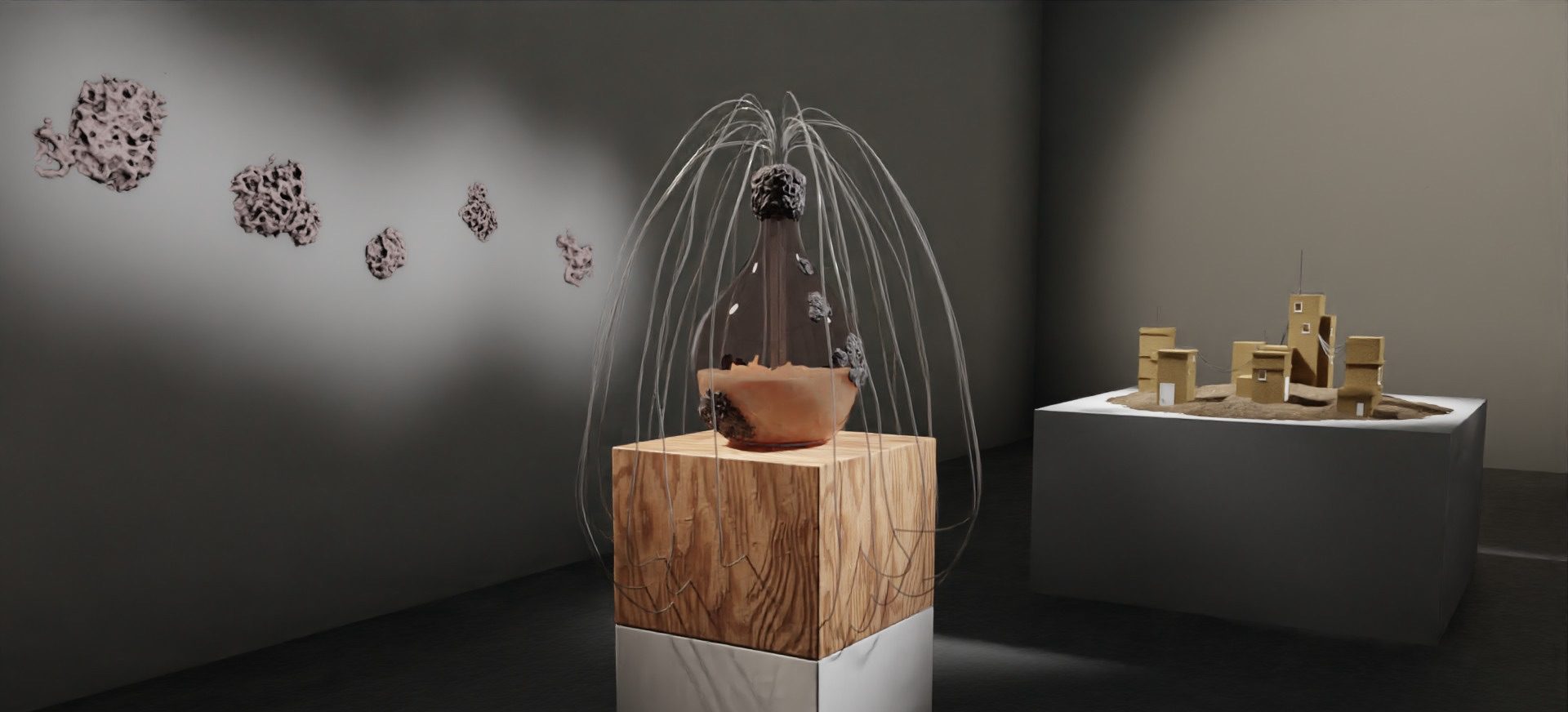
“Fermenting Futures” (2020 onwards) is a new body of work by artists Anna Dumitriu and Alex May that explores the significance of yeast biotechnology from a cultural and aesthetic perspective, engaging audiences in the history and future of this important but under-recognised field. The work is created in collaboration with Professor Diethard Mattanovich, Professor Michael Sauer, Dr. Özge Ata and Dr. Martin Altvater at the Institute of Microbiology and Microbial Biotechnology of the University of Natural Resources and Life Sciences Vienna, Austria. The central artwork in the series explores and physically contains a CRISPR modified Pichia pastoris yeast that is simultaneously able to capture carbon and output lactic acid for the manufacture of biodegradable PLA plastic - for 3D printing. The sculpture comprises a glass vessel containing the bubbling modified yeast, sustained by a mass of tubes, atop a block of horse chestnut wood. 3D printed yeast forms incorporating the yeast-produced PLA plastic swarm across the container. The artwork extends two research projects in the Institute of Microbiology and Microbial Biotechnology of the University of Natural Resources and Life Sciences in Vienna, which use genetic modification techniques and directed evolution. One project resulted in Pichia pastoris yeast capable of capturing carbon and using it to produce animal feed, and another where Saccharomyces cerevisiae yeast eats sugar and produces lactic acid. The aim of the work is to think about environmental pollution, and explore the use of yeast biotechnology to confront these global problems, as our atmosphere chokes with carbon dioxide and our seas clutter with plastic.
“Fermenting Futures” (2020 onwards) is a new body of work by artists Anna Dumitriu and Alex May that explores the significance of yeast biotechnology from a cultural and aesthetic perspective, engaging audiences in the history and future of this important but under-recognised field. The work is created in collaboration with Professor Diethard Mattanovich, Professor Michael Sauer, Dr. Özge Ata and Dr. Martin Altvater at the Institute of Microbiology and Microbial Biotechnology of the University of Natural Resources and Life Sciences Vienna, Austria. The central artwork in the series explores and physically contains a CRISPR modified Pichia pastoris yeast that is simultaneously able to capture carbon and output lactic acid for the manufacture of biodegradable PLA plastic - for 3D printing. The sculpture comprises a glass vessel containing the bubbling modified yeast, sustained by a mass of tubes, atop a block of horse chestnut wood. 3D printed yeast forms incorporating the yeast-produced PLA plastic swarm across the container. The artwork extends two research projects in the Institute of Microbiology and Microbial Biotechnology of the University of Natural Resources and Life Sciences in Vienna, which use genetic modification techniques and directed evolution. One project resulted in Pichia pastoris yeast capable of capturing carbon and using it to produce animal feed, and another where Saccharomyces cerevisiae yeast eats sugar and produces lactic acid. The aim of the work is to think about environmental pollution, and explore the use of yeast biotechnology to confront these global problems, as our atmosphere chokes with carbon dioxide and our seas clutter with plastic.