
Award 2021
Welcome to the Social Art Award 2021 – Online Gallery!
We are grateful for the many inspiring contributions from artists around the world. The selected works reflect a broad spectrum of contemporary social art practices and explore new relationships between humans, nature, and technology. They address themes such as ecological regeneration, climate justice, sustainable futures, social resilience, and more-than-human perspectives.
Below you will find the submissions from the Social Art Award 2021 – New Greening edition that passed the initial jury round. The Online Gallery offers public visibility to these works and encourages dialogue around their ideas and approaches; it does not replace the final jury decision.
Thank you to all artists for sharing your visionary and committed work. We invite you to explore the gallery and engage with the perspectives shaping New Greening.


Fronzen Sertão
Anais-karenin
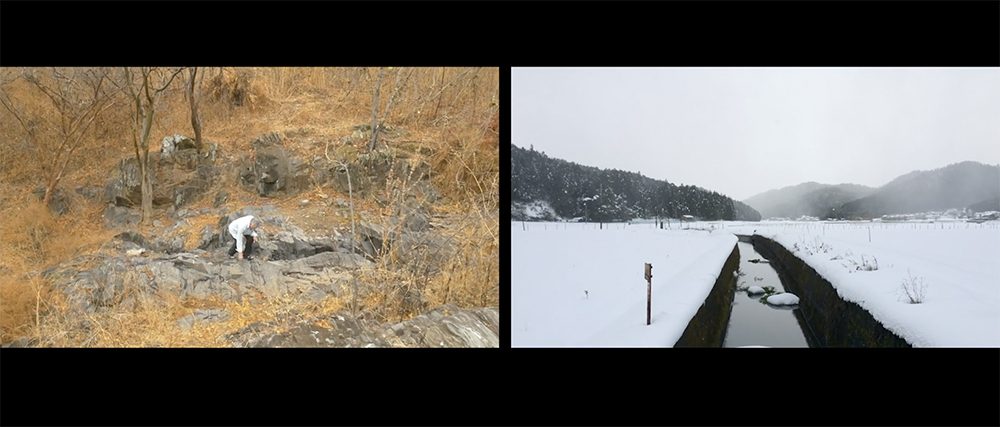
This work of videoart is a way to manifest the similar situation of vulnerability of humans in face of altered environments in different parts of the world. The images was recorded in Assaré, located in the dry backwood of Ceará, and in Nantan-shi, countryside of Kyoto, Japan. The Assaré region was completely transformed by drought, and the subsistence of the families who were living in this woods became impossible. Most of them migrated to the southwest to work as underemployed, upon the governs encouragement. Among them, my grandfather, who became a bricklayer, and my grandmother, who was hit by a car a few months after arriving in São Paulo. The forest of Nantan-shi village is covered by foreign pine, which was brought after the destruction of the native forest during World War II. This fact unfeasible the growth and collection of native Matsutake mushroom, which was the basis of the local economy. The region’s subsistence base became the cultivation and trade of rice, maintained by small family nuclei who uses toxic fertilizers.
This work of videoart is a way to manifest the similar situation of vulnerability of humans in face of altered environments in different parts of the world. The images was recorded in Assaré, located in the dry backwood of Ceará, and in Nantan-shi, countryside of Kyoto, Japan. The Assaré region was completely transformed by drought, and the subsistence of the families who were living in this woods became impossible. Most of them migrated to the southwest to work as underemployed, upon the governs encouragement. Among them, my grandfather, who became a bricklayer, and my grandmother, who was hit by a car a few months after arriving in São Paulo. The forest of Nantan-shi village is covered by foreign pine, which was brought after the destruction of the native forest during World War II. This fact unfeasible the growth and collection of native Matsutake mushroom, which was the basis of the local economy. The region’s subsistence base became the cultivation and trade of rice, maintained by small family nuclei who uses toxic fertilizers.