
Award 2021
Welcome to the Social Art Award 2021 – Online Gallery!
We are grateful for the many inspiring contributions from artists around the world. The selected works reflect a broad spectrum of contemporary social art practices and explore new relationships between humans, nature, and technology. They address themes such as ecological regeneration, climate justice, sustainable futures, social resilience, and more-than-human perspectives.
Below you will find the submissions from the Social Art Award 2021 – New Greening edition that passed the initial jury round. The Online Gallery offers public visibility to these works and encourages dialogue around their ideas and approaches; it does not replace the final jury decision.
Thank you to all artists for sharing your visionary and committed work. We invite you to explore the gallery and engage with the perspectives shaping New Greening.


Meer/Море
Jana Burger
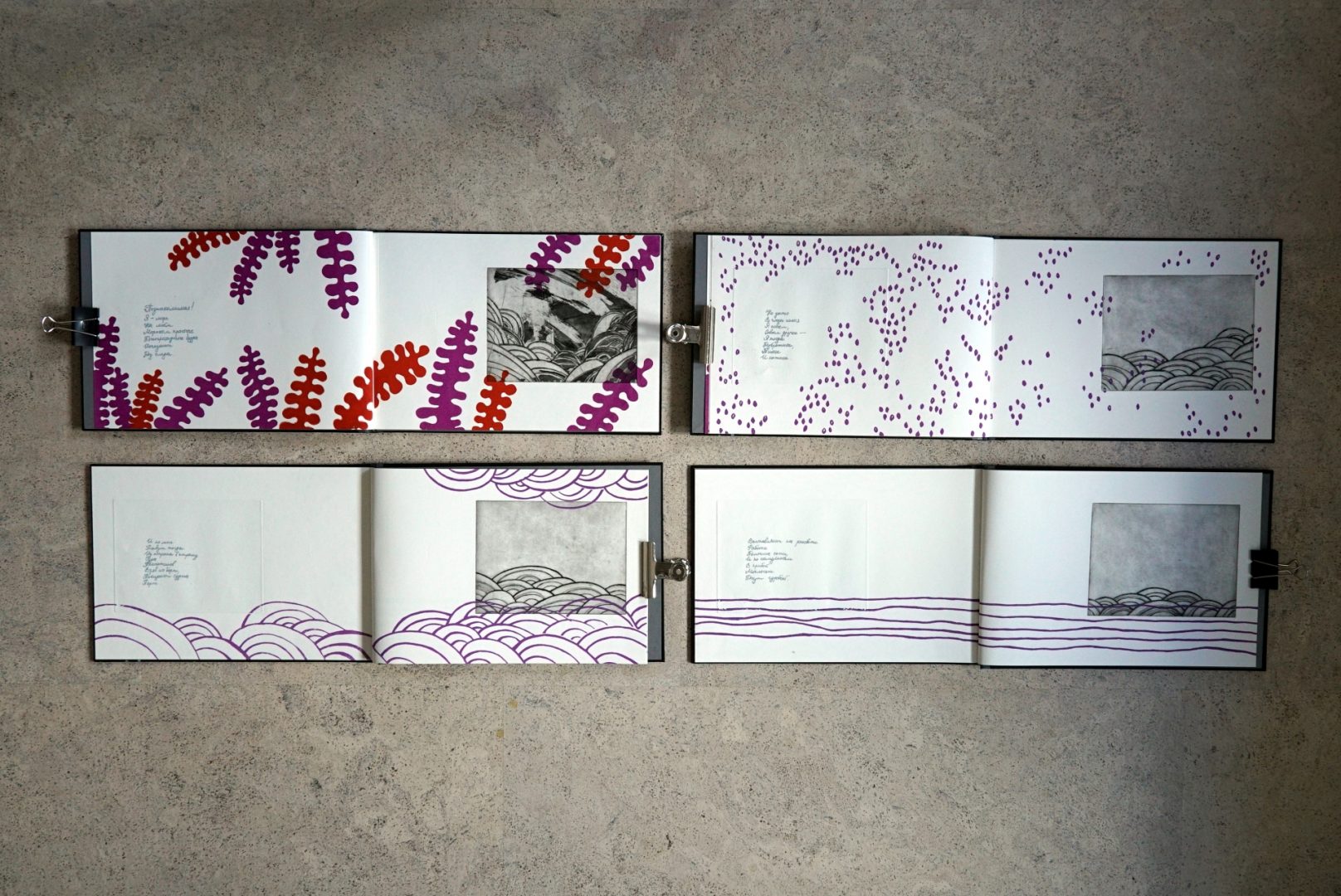
I saw the sea for the first time in St. Petersburg when I was 23 years old. Now I live on the Baltic Sea. The sea is very important for the region because it influences all aspects of life. The sea is not only a feast for the eyes and a tourist attraction, but also an important economic factor for the country. It gives people here the opportunity to work and live. As a homage to the Baltic Sea, I have produced four artist's books. They were made entirely by hand, including the binding. Two hand-printing techniques were used: screen printing and etching (aquatint). The book uses a Bulgarian children's poem translated into Russian by Roman Sef. The text describes that the sea, like man, can be stormy and cruel or calm and gentle. I specifically chose a children's poem because I didn't have the opportunity to see the sea in my childhood. I only knew it from poems and pictures. And now I have a great fear that future generations will also only know the beauty and integrity of the sea from books and pictures. For example, what are we to make of the decision in Japan that the radioactive water accumulated after the Fukushima accident is to be drained into the sea. It is simply shocking! I myself live in the immediate vicinity of the decommissioned Greifswald-Lubmin nuclear power plant, which is located directly on the Baltic Sea. And here, too, it has had and continues to have a major impact on its environment. For example, during its operation in GDR times, the water temperature of the Lubmin Bay increased, and today the deconstruction of the radioactively contaminated concrete of buildings has still not been finally clarified. Furthermore, one reads in the newspaper again and again about small accidents, which of course are always quite harmless. Like the World War II ammunition dumped off the coast, it represents a potential time bomb for the Baltic Sea.
I saw the sea for the first time in St. Petersburg when I was 23 years old. Now I live on the Baltic Sea. The sea is very important for the region because it influences all aspects of life. The sea is not only a feast for the eyes and a tourist attraction, but also an important economic factor for the country. It gives people here the opportunity to work and live. As a homage to the Baltic Sea, I have produced four artist's books. They were made entirely by hand, including the binding. Two hand-printing techniques were used: screen printing and etching (aquatint). The book uses a Bulgarian children's poem translated into Russian by Roman Sef. The text describes that the sea, like man, can be stormy and cruel or calm and gentle. I specifically chose a children's poem because I didn't have the opportunity to see the sea in my childhood. I only knew it from poems and pictures. And now I have a great fear that future generations will also only know the beauty and integrity of the sea from books and pictures. For example, what are we to make of the decision in Japan that the radioactive water accumulated after the Fukushima accident is to be drained into the sea. It is simply shocking! I myself live in the immediate vicinity of the decommissioned Greifswald-Lubmin nuclear power plant, which is located directly on the Baltic Sea. And here, too, it has had and continues to have a major impact on its environment. For example, during its operation in GDR times, the water temperature of the Lubmin Bay increased, and today the deconstruction of the radioactively contaminated concrete of buildings has still not been finally clarified. Furthermore, one reads in the newspaper again and again about small accidents, which of course are always quite harmless. Like the World War II ammunition dumped off the coast, it represents a potential time bomb for the Baltic Sea.