Award 2021
Welcome to the Social Art Award 2021 – Online Gallery!
We are grateful for the many inspiring contributions from artists around the world. The selected works reflect a broad spectrum of contemporary social art practices and explore new relationships between humans, nature, and technology. They address themes such as ecological regeneration, climate justice, sustainable futures, social resilience, and more-than-human perspectives.
Below you will find the submissions from the Social Art Award 2021 – New Greening edition that passed the initial jury round. The Online Gallery offers public visibility to these works and encourages dialogue around their ideas and approaches; it does not replace the final jury decision.
Thank you to all artists for sharing your visionary and committed work. We invite you to explore the gallery and engage with the perspectives shaping New Greening.
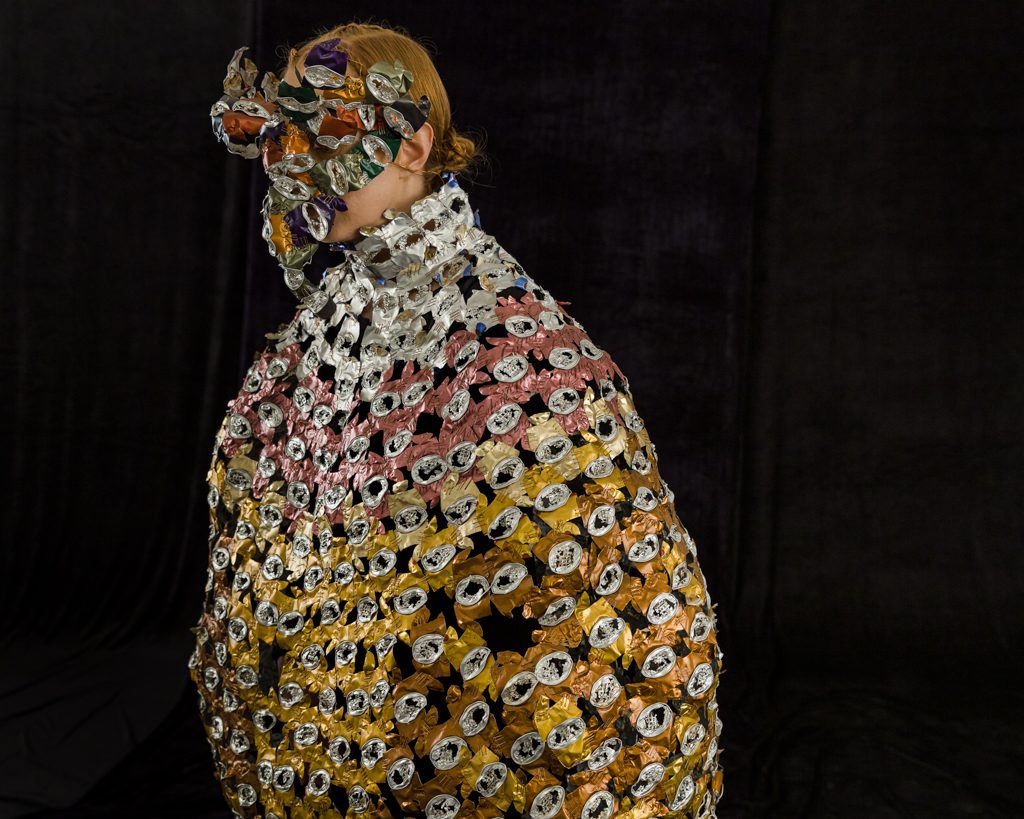


Cage dress and mask
SANDRA LAPAGE
What if our current crisis was mainly a crisis of knowledge? What if we realized that the hyper-specialization of our concerns and areas of knowledge were leading us to a myopic, or worse, cynical blindness? How to reestablish a cosmogonic vision of the world, when human evolution is impulsed by technical, economic and scientific development, while there is an evident ethical, psychological and affective degradation? Magical thought is at the base of myths and folklore, offering an analogy between microcosm (human spirit, mind, and body), and a macrocosm (cosmos, universe and nature). In this way of thought, there is a connection between name and thing, between object and image. I believe that it is possible to speak of magic from a secular point of view. After all, Junge speaks of Mana, Bergson of “élan vital”, Jane Bennett of vibrant matter, and Jeremy Narby of universal genetic communication through DNA. I present art as shamanic practice and trance as a source of knowledge, embracing heterogenous epistemologies without falling into superstition. I create sculptures from trash and discarded materials which are often malleable and even wearable, and address a series of environmental and behavioral issues. These sculptures unfold into installations and photo-performances. Control is an illusion, and through the work, I exercise the acceptance of what recycled and everyday materials reveal, from accidents to new processes. The vital materiality of quotidian objects is my starting point and leads me to a reevaluation of the dichotomy between life/inanimate, human/nature.
What if our current crisis was mainly a crisis of knowledge? What if we realized that the hyper-specialization of our concerns and areas of knowledge were leading us to a myopic, or worse, cynical blindness? How to reestablish a cosmogonic vision of the world, when human evolution is impulsed by technical, economic and scientific development, while there is an evident ethical, psychological and affective degradation? Magical thought is at the base of myths and folklore, offering an analogy between microcosm (human spirit, mind, and body), and a macrocosm (cosmos, universe and nature). In this way of thought, there is a connection between name and thing, between object and image. I believe that it is possible to speak of magic from a secular point of view. After all, Junge speaks of Mana, Bergson of “élan vital”, Jane Bennett of vibrant matter, and Jeremy Narby of universal genetic communication through DNA. I present art as shamanic practice and trance as a source of knowledge, embracing heterogenous epistemologies without falling into superstition. I create sculptures from trash and discarded materials which are often malleable and even wearable, and address a series of environmental and behavioral issues. These sculptures unfold into installations and photo-performances. Control is an illusion, and through the work, I exercise the acceptance of what recycled and everyday materials reveal, from accidents to new processes. The vital materiality of quotidian objects is my starting point and leads me to a reevaluation of the dichotomy between life/inanimate, human/nature.