
Welcome to the Social Art Award 2025 – Online Gallery!
We are grateful for the many powerful contributions from artists across the globe. The selected works reflect the diversity of contemporary social art practices and address urgent issues such as climate and water crises, social and economic inequality, migration, conflict, discrimination, and the protection of human and more-than-human life.
Below you will find the submissions from the edition of 2024/2025 that passed the initial jury round. The Online Gallery offers public visibility to these works and supports dialogue around their themes; it does not replace the final jury decision.
Thank you to all artists for sharing your inspiring and committed work. We invite you to explore the gallery and engage with the perspectives shaping the Social Art Award 2025.


I can't see the Earth disappearing.
wenyu Zhu
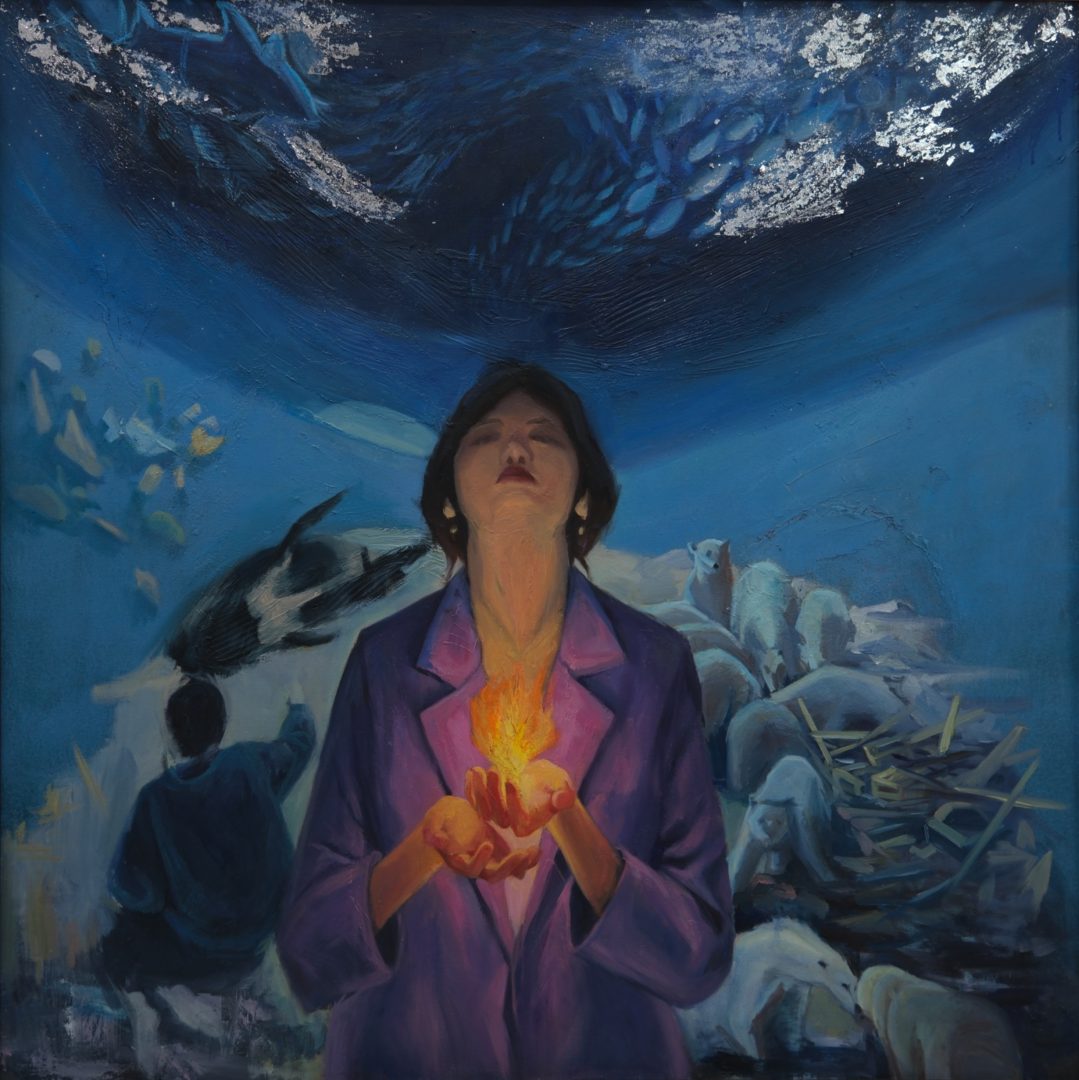
At first, no one paid attention to this disaster; it was just a forest fire, a drought, the extinction of a species, and the disappearance of a city, until the disaster became closely related to everyone. Picture description: Because of the melting of glaciers, polar bears have nowhere to live and become scavengers that feed on human leftovers. The stranded whales on the beach, human pollution of the ocean, and the destruction of marine ecology, as well as the garbage floating on the sea surface, all seem far away from us. At the other end, one species after another is extinct, and the ice is melting continuously. The greenhouse effect brings chaos to the ecosystem. The increase in sea water temperature leads to a decrease in oxygen, forming an anoxic sea area. Marine life has no choice but to find new habitats to escape. The person in the center of the picture faces us, holding a fire in his hand. The fire represents the starting point of human civilization and contrasts with the melting glacier behind. The person in the center of the image faces the viewer, and the cries in the background are invisible. Above the picture are deep-sea fish, sardines, whales, and tuna, swimming freely in an s-shaped formation, in contrast with the crying person and the crying polar bear below.
At first, no one paid attention to this disaster; it was just a forest fire, a drought, the extinction of a species, and the disappearance of a city, until the disaster became closely related to everyone. Picture description: Because of the melting of glaciers, polar bears have nowhere to live and become scavengers that feed on human leftovers. The stranded whales on the beach, human pollution of the ocean, and the destruction of marine ecology, as well as the garbage floating on the sea surface, all seem far away from us. At the other end, one species after another is extinct, and the ice is melting continuously. The greenhouse effect brings chaos to the ecosystem. The increase in sea water temperature leads to a decrease in oxygen, forming an anoxic sea area. Marine life has no choice but to find new habitats to escape. The person in the center of the picture faces us, holding a fire in his hand. The fire represents the starting point of human civilization and contrasts with the melting glacier behind. The person in the center of the image faces the viewer, and the cries in the background are invisible. Above the picture are deep-sea fish, sardines, whales, and tuna, swimming freely in an s-shaped formation, in contrast with the crying person and the crying polar bear below.