
Welcome to the Social Art Award 2025 – Online Gallery!
We are grateful for the many powerful contributions from artists across the globe. The selected works reflect the diversity of contemporary social art practices and address urgent issues such as climate and water crises, social and economic inequality, migration, conflict, discrimination, and the protection of human and more-than-human life.
Below you will find the submissions from the edition of 2024/2025 that passed the initial jury round. The Online Gallery offers public visibility to these works and supports dialogue around their themes; it does not replace the final jury decision.
Thank you to all artists for sharing your inspiring and committed work. We invite you to explore the gallery and engage with the perspectives shaping the Social Art Award 2025.
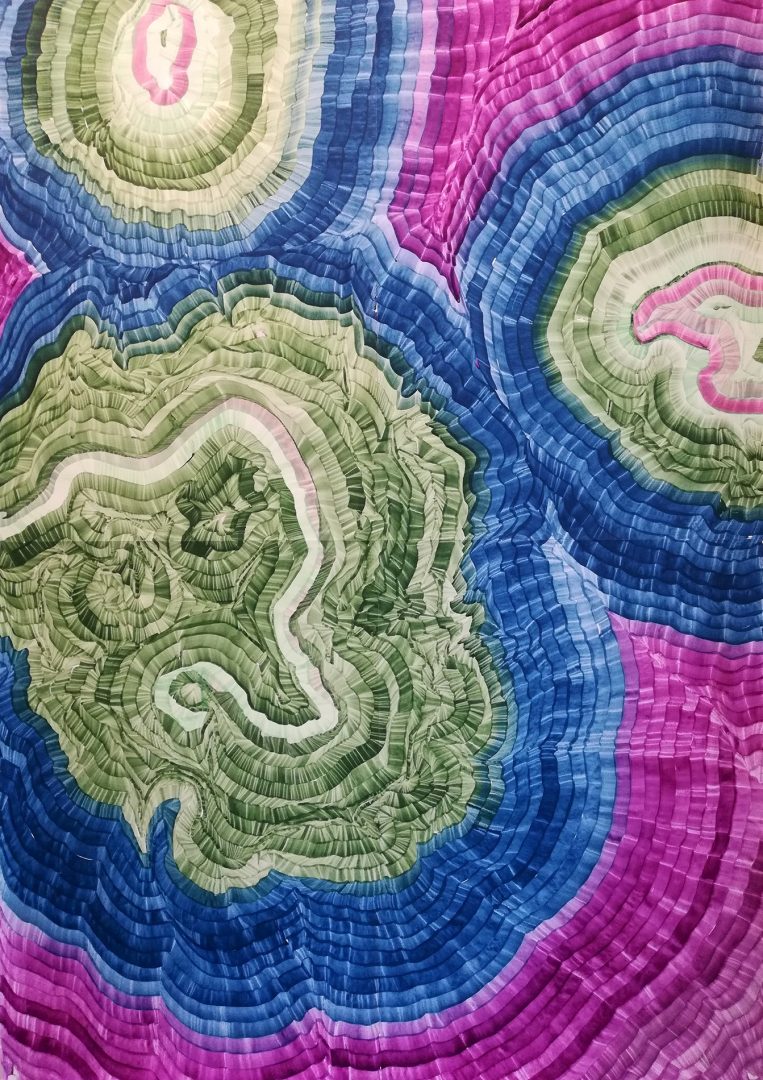


Undercurrent 3
phil
200x140cm, Acrylic on 4 joined papers. This piece reflects the delicate balance between oceanic and terrestrial ecosystems. The deep blues and purples evoke the movement of water, currents that shape life, while the vibrant greens symbolize marine vegetation like kelp forests and seagrass meadows, silent healers of our oceans. These natural filters produce oxygen, absorb carbon, and shelter marine species, yet they are increasingly at risk. The layered, rhythmic forms mirror both geological time and the unseen forces shaping our planet. As the tides shift, so does the fate of these ecosystems. Will we allow nature to restore itself, or will we disrupt its fragile harmony?
200x140cm, Acrylic on 4 joined papers. This piece reflects the delicate balance between oceanic and terrestrial ecosystems. The deep blues and purples evoke the movement of water, currents that shape life, while the vibrant greens symbolize marine vegetation like kelp forests and seagrass meadows, silent healers of our oceans. These natural filters produce oxygen, absorb carbon, and shelter marine species, yet they are increasingly at risk. The layered, rhythmic forms mirror both geological time and the unseen forces shaping our planet. As the tides shift, so does the fate of these ecosystems. Will we allow nature to restore itself, or will we disrupt its fragile harmony?