
Welcome to the Social Art Award 2025 – Online Gallery!
We are grateful for the many powerful contributions from artists across the globe. The selected works reflect the diversity of contemporary social art practices and address urgent issues such as climate and water crises, social and economic inequality, migration, conflict, discrimination, and the protection of human and more-than-human life.
Below you will find the submissions from the edition of 2024/2025 that passed the initial jury round. The Online Gallery offers public visibility to these works and supports dialogue around their themes; it does not replace the final jury decision.
Thank you to all artists for sharing your inspiring and committed work. We invite you to explore the gallery and engage with the perspectives shaping the Social Art Award 2025.
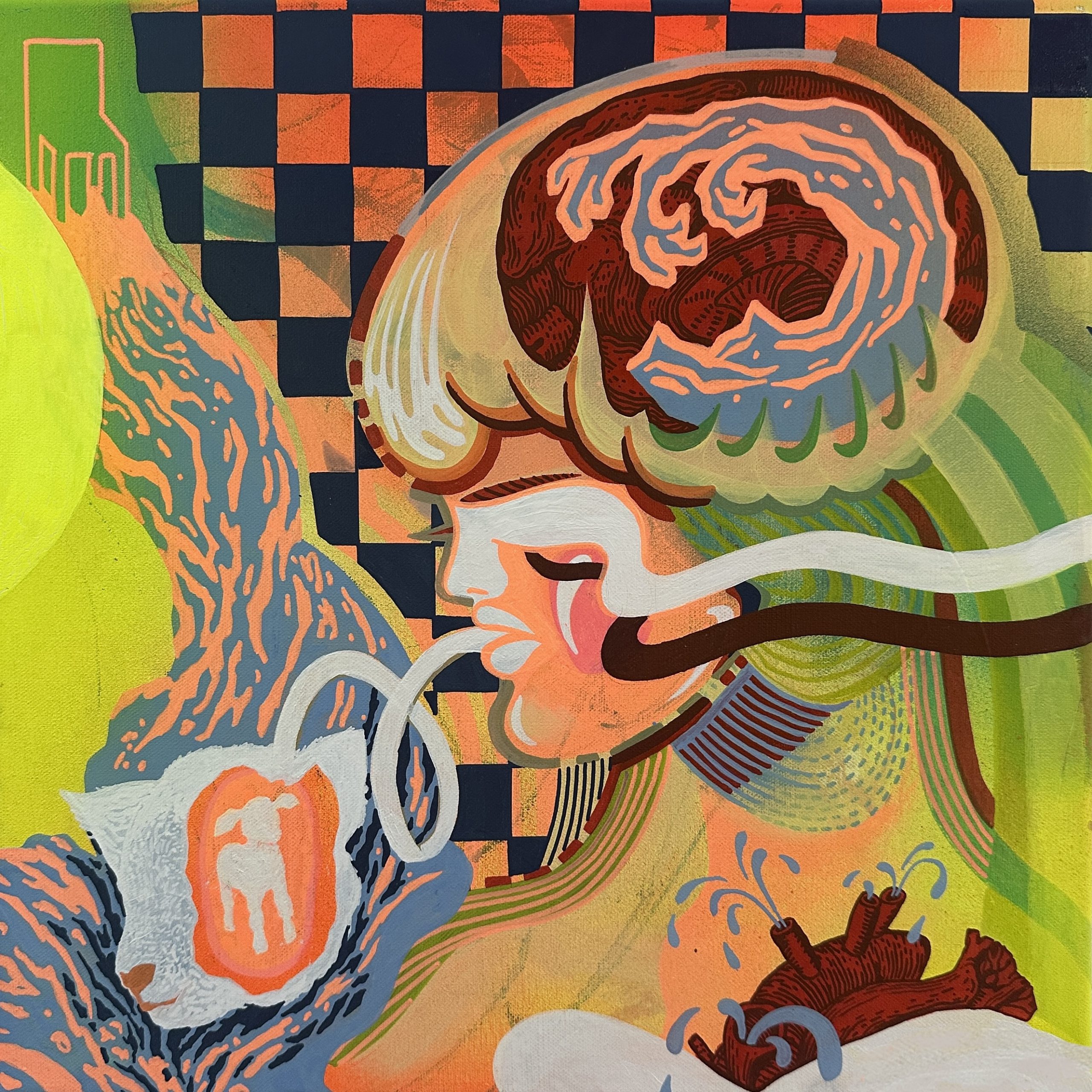


Honeymoon at the Cascade
Egle Tamulyte
It is a symbolic vision of longing - for water, for purity, for a return to harmony. Just as we are drawn to breathtaking places during a honeymoon, we are drawn to water. The central figure, a woman with a bridal aura, leans toward a shared stream with a lamb. Their simultaneous drinking speaks to a primal kinship between humans and animals. The lamb, symbol of purity and vulnerability, reflects our own fragile hope that what we consume will be clean, nourishing, and justly given. The ocean-like wave inside the woman’s head reminds us we are water -emotionally, biologically, spiritually. A towering chair looms in the background - a metaphor for authority. Is it divine provision or institutional control? Who truly governs our access to water: nature, the state, or the private sector? The chair invites us to question the systems behind the source, exposing the tension between care and control, blessing and ownership.
It is a symbolic vision of longing - for water, for purity, for a return to harmony. Just as we are drawn to breathtaking places during a honeymoon, we are drawn to water. The central figure, a woman with a bridal aura, leans toward a shared stream with a lamb. Their simultaneous drinking speaks to a primal kinship between humans and animals. The lamb, symbol of purity and vulnerability, reflects our own fragile hope that what we consume will be clean, nourishing, and justly given. The ocean-like wave inside the woman’s head reminds us we are water -emotionally, biologically, spiritually. A towering chair looms in the background - a metaphor for authority. Is it divine provision or institutional control? Who truly governs our access to water: nature, the state, or the private sector? The chair invites us to question the systems behind the source, exposing the tension between care and control, blessing and ownership.