Welcome to the Social Art Award 2025 – Online Gallery!
We are grateful for the many powerful contributions from artists across the globe. The selected works reflect the diversity of contemporary social art practices and address urgent issues such as climate and water crises, social and economic inequality, migration, conflict, discrimination, and the protection of human and more-than-human life.
Below you will find the submissions from the edition of 2024/2025 that passed the initial jury round. The Online Gallery offers public visibility to these works and supports dialogue around their themes; it does not replace the final jury decision.
Thank you to all artists for sharing your inspiring and committed work. We invite you to explore the gallery and engage with the perspectives shaping the Social Art Award 2025.


Machangaragua
Ricardo Cabrera Zambrano
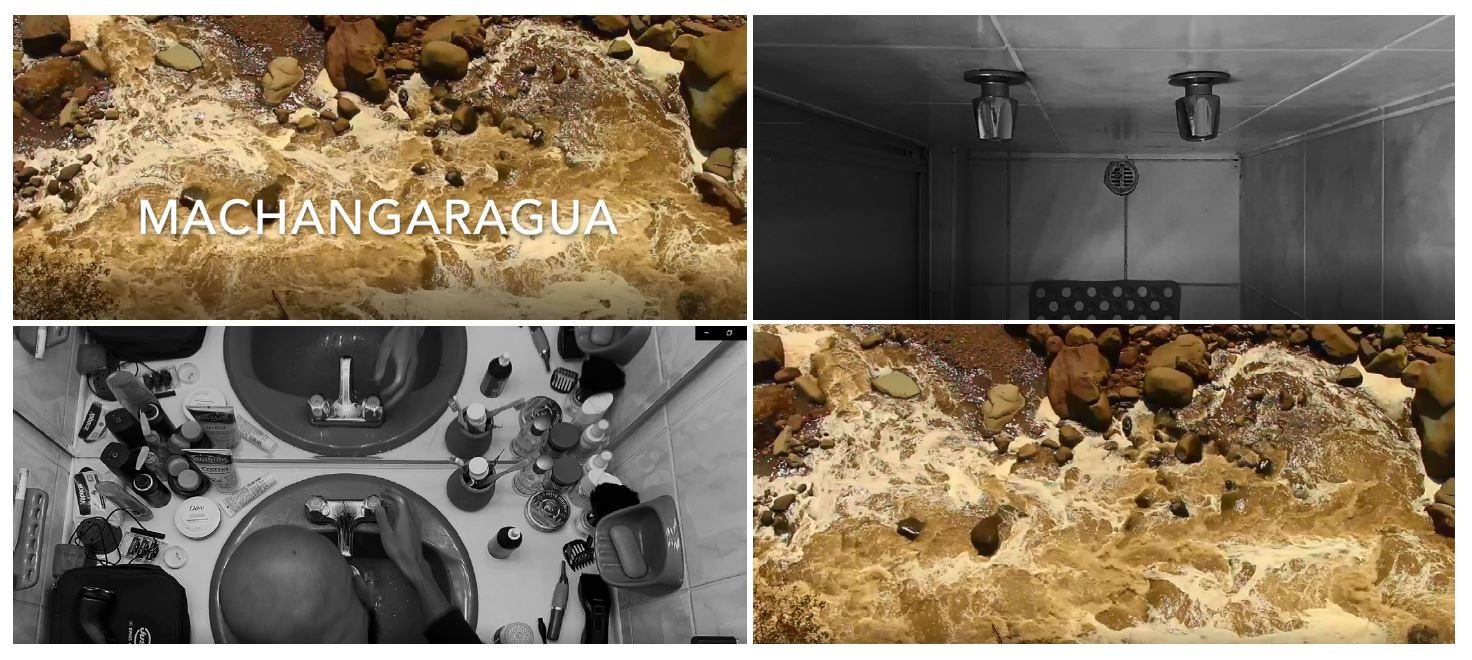
This artistic process included the study of tributaries, generating a photo and video archive that allowed us to explore the watershed from multiple perspectives. Through diverse plans and digital editing, the project advanced towards a pictorial and sound abstraction. Satellite tools and symbolic references, such as the snake in the Andean cosmovision, were used to represent the river. Reflecting on water in everyday life, questions arose about its consumption and control, inspired by the poem El río de la ciudad natal by Carrera Andrade. The sensorial guided the exploration, registering elements such as a leak and analyzing the natural rhythm of water. The illusion of water control was approached from an unbiased perspective, seeking to understand its flow. As part of the process, water samples were taken at the Guápulo bridge, reinforcing the connection between the tangible reality and the artistic perception of the river.
This artistic process included the study of tributaries, generating a photo and video archive that allowed us to explore the watershed from multiple perspectives. Through diverse plans and digital editing, the project advanced towards a pictorial and sound abstraction. Satellite tools and symbolic references, such as the snake in the Andean cosmovision, were used to represent the river. Reflecting on water in everyday life, questions arose about its consumption and control, inspired by the poem El río de la ciudad natal by Carrera Andrade. The sensorial guided the exploration, registering elements such as a leak and analyzing the natural rhythm of water. The illusion of water control was approached from an unbiased perspective, seeking to understand its flow. As part of the process, water samples were taken at the Guápulo bridge, reinforcing the connection between the tangible reality and the artistic perception of the river.