
Award 2021
Welcome to the Social Art Award 2021 – Online Gallery!
We are grateful for the many inspiring contributions from artists around the world. The selected works reflect a broad spectrum of contemporary social art practices and explore new relationships between humans, nature, and technology. They address themes such as ecological regeneration, climate justice, sustainable futures, social resilience, and more-than-human perspectives.
Below you will find the submissions from the Social Art Award 2021 – New Greening edition that passed the initial jury round. The Online Gallery offers public visibility to these works and encourages dialogue around their ideas and approaches; it does not replace the final jury decision.
Thank you to all artists for sharing your visionary and committed work. We invite you to explore the gallery and engage with the perspectives shaping New Greening.
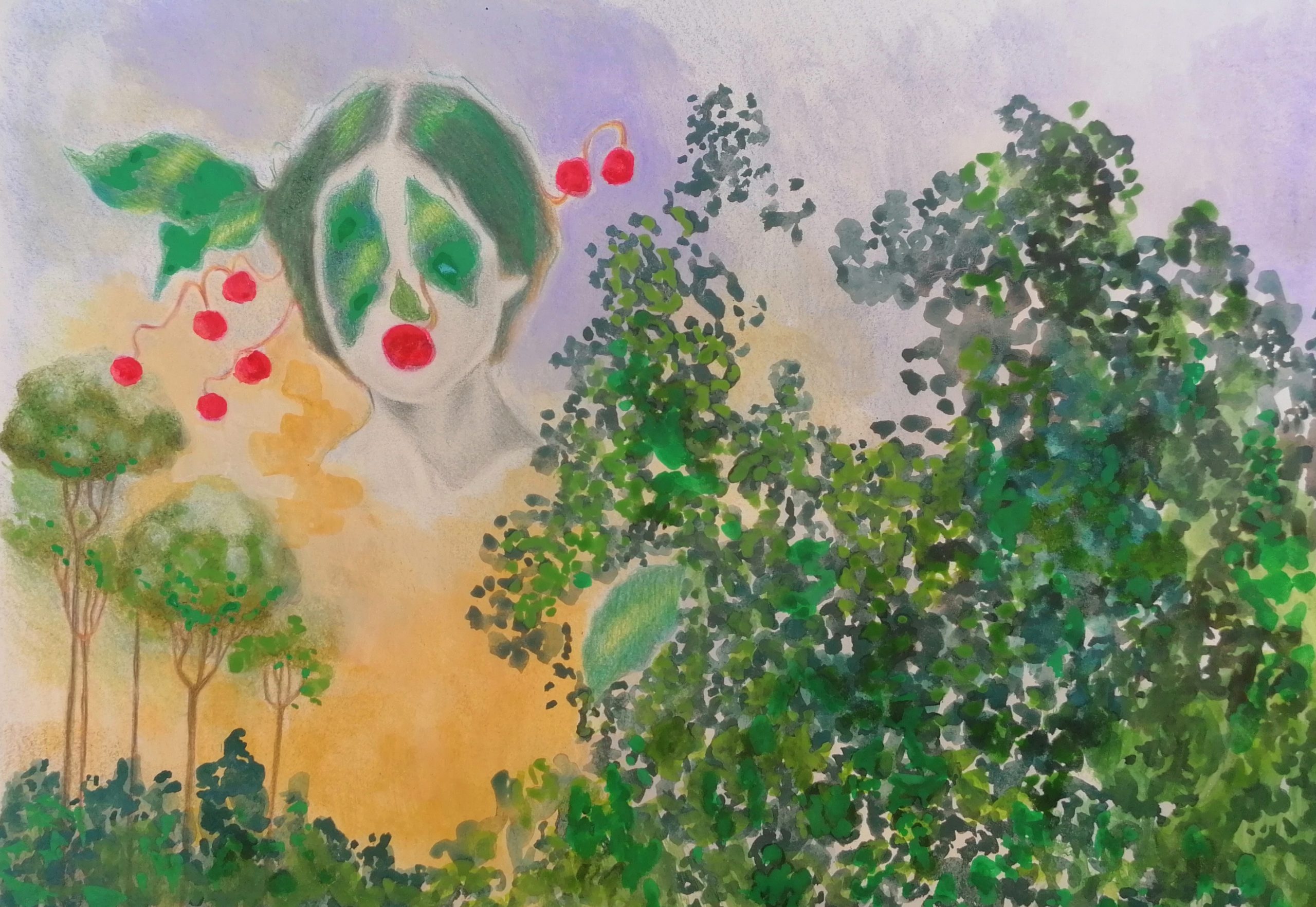


Persistence after human hegemony
Michelle Vazquez Sanz
Persistence after human hegemony is a pictorial project within the field of science fiction, about a future world in which the human species has become extinct and therefore there is an emancipation of nature that empowers species of the plant and animal kingdom, filling the planet with organic forms that have not been present until now and have capacities such as intelligence, memory, vision and floating. The human being appears in an ethereal state, as a memory of nature, and in this distant time is unable to intervene. Each painting in the project is the representation of an everyday scene from this post-apocalyptic world. Organic persistence after human hegemony aims to achieve through the resources of figurative painting, a new perception of the forms of plant life and their positive reaction to our absence. At the same time, encourage reflections around the impact of human beings on nature in order to contribute actions to the formation of a more solid ecological culture in our society. The pictorial references of this project are artists who have developed projects of interest to nature or science fiction, such as Georgia O’keefe, Zdzislaw Beksinski, Roger Dean, William Turner and Tomás Micek. Conceptual referents of this project are Hope Jahren, David G. Jara, and Stefano Mancuso, who have also contributed to these interests from other professional fields. Art has aesthetic functions that new greening projects can benefit from to generate positive change in society. In addition, art is the reflection of the ideology of a society, if we start by making ecological changes there we will soon see them in our daily lives.
Persistence after human hegemony is a pictorial project within the field of science fiction, about a future world in which the human species has become extinct and therefore there is an emancipation of nature that empowers species of the plant and animal kingdom, filling the planet with organic forms that have not been present until now and have capacities such as intelligence, memory, vision and floating. The human being appears in an ethereal state, as a memory of nature, and in this distant time is unable to intervene. Each painting in the project is the representation of an everyday scene from this post-apocalyptic world. Organic persistence after human hegemony aims to achieve through the resources of figurative painting, a new perception of the forms of plant life and their positive reaction to our absence. At the same time, encourage reflections around the impact of human beings on nature in order to contribute actions to the formation of a more solid ecological culture in our society. The pictorial references of this project are artists who have developed projects of interest to nature or science fiction, such as Georgia O’keefe, Zdzislaw Beksinski, Roger Dean, William Turner and Tomás Micek. Conceptual referents of this project are Hope Jahren, David G. Jara, and Stefano Mancuso, who have also contributed to these interests from other professional fields. Art has aesthetic functions that new greening projects can benefit from to generate positive change in society. In addition, art is the reflection of the ideology of a society, if we start by making ecological changes there we will soon see them in our daily lives.