
Award 2021
Welcome to the Social Art Award 2021 – Online Gallery!
We are grateful for the many inspiring contributions from artists around the world. The selected works reflect a broad spectrum of contemporary social art practices and explore new relationships between humans, nature, and technology. They address themes such as ecological regeneration, climate justice, sustainable futures, social resilience, and more-than-human perspectives.
Below you will find the submissions from the Social Art Award 2021 – New Greening edition that passed the initial jury round. The Online Gallery offers public visibility to these works and encourages dialogue around their ideas and approaches; it does not replace the final jury decision.
Thank you to all artists for sharing your visionary and committed work. We invite you to explore the gallery and engage with the perspectives shaping New Greening.
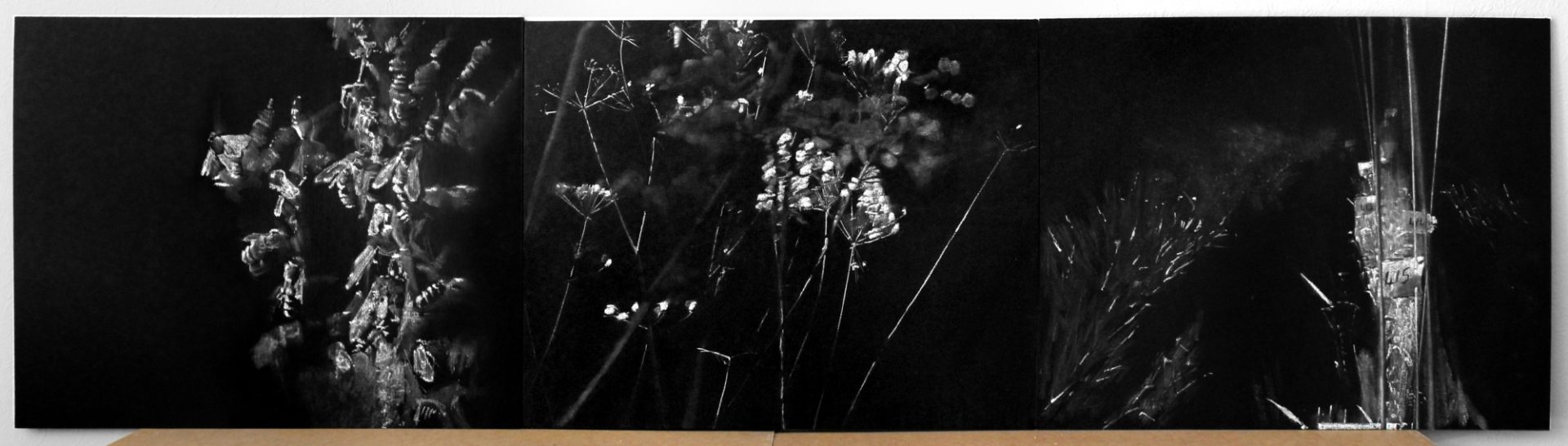


Colony to Colonised : A Story of a Furlong
monika dutta
'Colony to Colonised: A Story of a Furlong' is a triptych work comprising three discrete chalk drawings on blackboard panels. The piece documents three phenomena at increasing distances within a furlong from my home. A colony of wild honey bees have inhabited the roof for several years, depending heavily on the immediate profusion of hogweed and cow parsley which, left to their own devices, increase in density each year. On the other side of the hedgerow, extensive industrial farmland is given over to pesticide trials, testing the economic viability of new insecticides and herbicides. The work evidences the precarious balance of habitat and land use, and reflects my ongoing exploration of the impact of the Anthropocene, focusing specifically on relationships between biodiversity and industrial agriculture.
'Colony to Colonised: A Story of a Furlong' is a triptych work comprising three discrete chalk drawings on blackboard panels. The piece documents three phenomena at increasing distances within a furlong from my home. A colony of wild honey bees have inhabited the roof for several years, depending heavily on the immediate profusion of hogweed and cow parsley which, left to their own devices, increase in density each year. On the other side of the hedgerow, extensive industrial farmland is given over to pesticide trials, testing the economic viability of new insecticides and herbicides. The work evidences the precarious balance of habitat and land use, and reflects my ongoing exploration of the impact of the Anthropocene, focusing specifically on relationships between biodiversity and industrial agriculture.